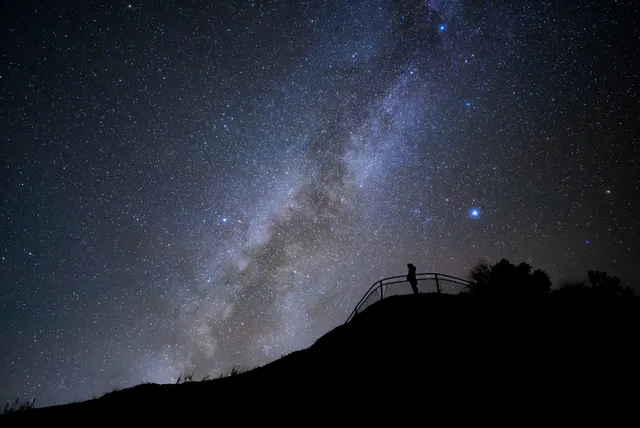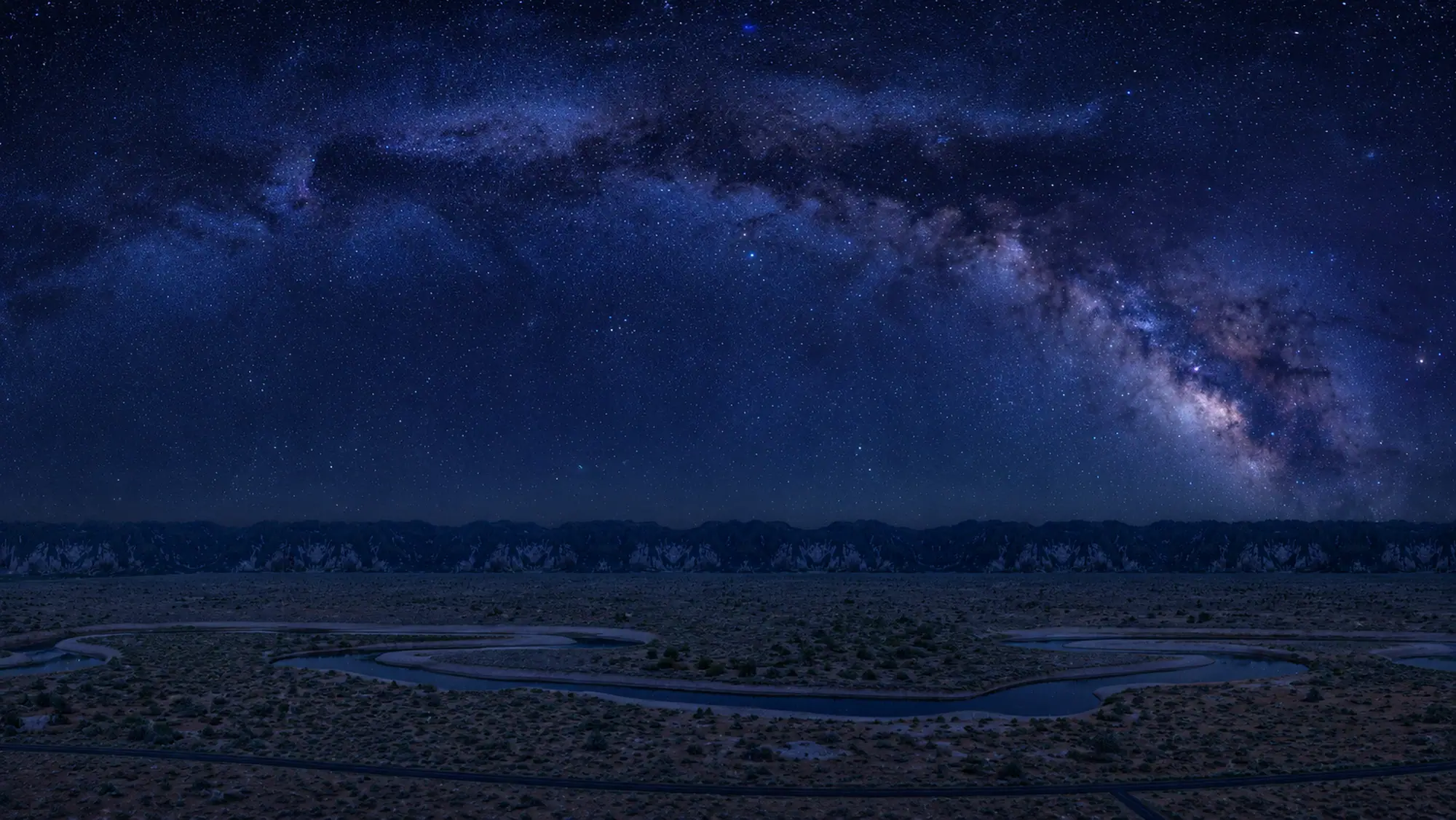

The Bortle scale is a nine-level rating of how dark the night sky is at a given spot. It runs from Class 1, the darkest skies on Earth, to Class 9, an inner-city sky. Amateur astronomer John E. Bortle published it in the February 2001 issue of Sky & Telescope to help skywatchers judge and compare observing sites.
The Bortle Scale in Brief
The Bortle scale sorts night skies into classes by what a person can see with the naked eye from one spot. Each step from Class 1 to Class 9 adds light pollution and takes faint objects out of view.


Sleep Under Dark Skies Near Bryce and Glacier
Get early access to our pyramids near Bryce Canyon and Glacier, with priority booking to all locations.
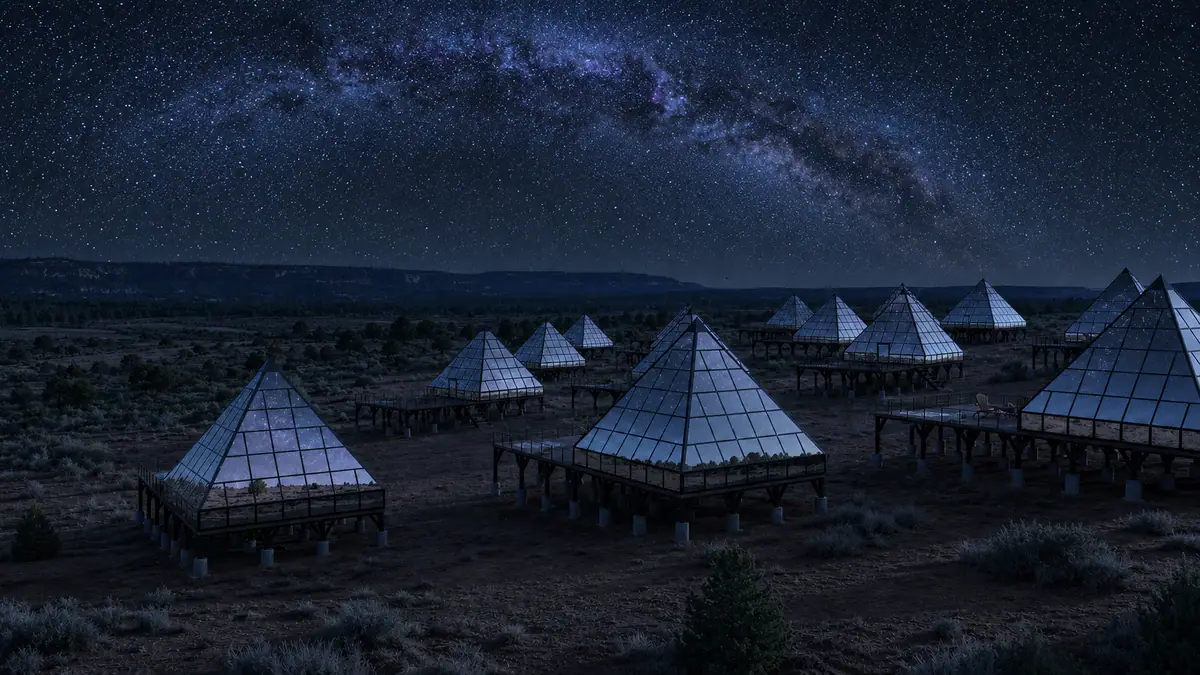
Concept renderings
Bortle described each class through markers in the sky: the Milky Way, the zodiacal light, star clusters, and how clouds look against the background. The classes also line up with two measurements: naked-eye limiting magnitude (NELM) and sky quality meter (SQM) readings of skyglow.
At the bright end of the scale, broad light domes loom over the horizon and wash out the Milky Way, leaving fewer stars and planets visible to the eye. At the dark end, light domes appear only toward cities or not at all, stars crowd the sky, and the zodiacal light glows with color.
Class 4.5, the semi-suburban or transition sky, sits between Class 4 and Class 5.
Bortle Class by Class
Each Bortle class has a title, a NELM range, an approximate SQM range and a set of sky markers you can check by eye.
| Class | Title | NELM | Approx. SQM | What you see |
|---|---|---|---|---|
| 1 | Excellent dark-sky site | 7.6 to 8.0 | 21.76 to 22.0 | Colorful zodiacal light; gegenschein and airglow readily visible; Milky Way in Scorpius and Sagittarius casts obvious shadows; M33 visible to the naked eye |
| 2 | Typical truly dark site | 7.1 to 7.5 | 21.6 to 21.75 | Zodiacal light bright enough to cast shadows at dusk and dawn; clouds show as dark holes; summer Milky Way highly structured |
| 3 | Rural sky | 6.6 to 7.0 | 21.3 to 21.6 | Some light pollution at the horizon; clouds lit near the horizon and dark overhead; summer Milky Way still complex |
| 4 | Brighter rural | 6.3 to 6.5 | 20.8 to 21.3 | Light domes in several directions; Milky Way impressive well above the horizon but lacking detail |
| 4.5 | Semi-suburban/transition | 6.1 to 6.3 | 20.3 to 20.8 | Clouds glow gray overhead; Milky Way vague 10 to 15 degrees above the horizon; Great Rift still obvious overhead in good transparency |
| 5 | Suburban sky | 5.6 to 6.0 | 19.25 to 20.3 | Light pollution in most directions; clouds brighter than the sky; Milky Way invisible near the horizon and washed out overhead |
| 6 | Bright suburban sky | 5.1 to 5.5 | 18.5 to 19.25 | No zodiacal light; sky within 35 degrees of the horizon glows grayish white; Milky Way only near the zenith |
| 7 | Suburban/urban transition | 4.6 to 5.0 | 18.00 to 18.5 | Whole sky light gray; clouds brightly lit; Milky Way nearly or totally invisible |
| 8 | City sky | 4.1 to 4.5 | Below 18.00 | Sky light gray or orange and bright enough to read by; familiar constellations weak or missing |
| 9 | Inner-city sky | 4.0 or less | Below 18.00 | Many constellations invisible; the Moon, planets, bright satellites and a few bright star clusters remain |
A wide database of sky quality meter readings lets anyone estimate a Bortle rating for any place in the world.
How to Estimate Your Own Sky
On any clear night, you can estimate your Bortle class by eye using the sky markers John Bortle built the scale around. Step outdoors and work through these field checks:
- The Milky Way. Highly structured means Class 2 or darker. Complex but softer points to Class 3. Impressive without detail suggests Class 4. Washed out overhead suggests Class 5. A faint cloud or nothing at all means Class 7 or brighter.
- The clouds. Dark holes against the stars mean Class 2. Clouds lit only near the horizon point to Class 3, while clouds brighter than the sky mean Class 5. Brightly lit clouds belong to Class 7.
- The ground. At Class 2 your surroundings are barely visible as silhouettes. At Class 4 they are clearly visible even at a distance, and at Class 8 you can read easily.
- The horizon. Light domes in several directions mean Class 4. Domes in most or all directions mean Class 5, and an evenly light gray sky means Class 7.
- The constellations. If familiar patterns look weak or broken, you are in Class 8 or Class 9.
A handheld sky quality meter gives your sky a number you can match to the table above, and a reading above 21.6 points to Class 2 or darker.
You can estimate your area's Bortle class before you pack your gear for the night. The Wikipedia entry for the Bortle scale links an interactive light pollution map you can use for this research.
Limits of the Class Descriptions
The darkest category descriptions can occasionally promise more than what a typical skywatcher observes. In a 2014 paper, Andrew Crumey argued that Bortle may have set an overly optimistic standard for how easily faint targets appear, even under the darkest skies. Diffuse objects such as M33 are harder to see than single stars of the same brightness, so naming M33 as a naked-eye object sets a high bar.
The same paper views a NELM above 7.1, which Bortle assigned to Class 2, as a substantial leap in expectation compared to the more frequently cited 6.0 to 6.5 range. Bortle knew that NELM changes with each observer's eyesight, and he wrote the scale as an alternative to raw NELM.
If pinpointing M33 or counting faint stars proves difficult, focus your attention on the primary Milky Way, cloud, and horizon checks outlined above.
Why the Bortle Scale Matters for Seeing the Milky Way
Your Bortle class decides what kind of Milky Way you will see, from a shadow-casting band at Class 1 to a faint cloud, or nothing, at Class 7.
- Class 1: the Scorpius and Sagittarius regions of the Milky Way cast obvious shadows, while dense starfields obscure fainter constellation boundaries.
- Class 2: the summer Milky Way shows highly structured detail.
- Class 3: the summer Milky Way retains a complex, textured presentation.
- Class 4: the Milky Way standing high above the horizon looks impressive, though it lacks finer inner details.
- Class 4.5: the band appears faint low along the horizon, while the Great Rift remains obvious directly overhead under clear skies.
- Class 5: the Milky Way fades completely near the horizon and appears washed out overhead, leaving the winter Milky Way barely noticeable even at the zenith.
- Class 6: the Milky Way reveals itself only near the zenith.
- Class 7: the Milky Way is nearly or totally invisible, appearing at most like a pale passing cloud.
To view the Milky Way with distinct, sculpted dust structure, plan your stargazing for sites rated Class 3 or darker.
The stargazing and dark sky guide walks you through the rest of the night-sky basics.
Finding Bortle Class 1 and 2 Skies
Bortle originally introduced the scale because encroaching light pollution was pushing dark sites out of reach for amateur astronomers. Ongoing urbanization and the switch to LED lighting have continued that trend, and the higher color temperature of LED lights has been a particular contributor.
To explore how dark skies look in one celebrated park setting, see our in-depth guide to stargazing at Bryce Canyon.
At Dark Light Collection, we are building glass pyramids for sky-gazing on private land at two sites, opening in 2027. One destination sits about 15 minutes from Bryce Canyon National Park in Utah, and our Montana retreat rests within 15 minutes of Glacier National Park's West Entrance. Each pyramid features a king bed positioned for sky-gazing and a private deck with your own personal telescope. Read why dark skies matter to see why we build under dark skies, and place a founding deposit on the reservation page to choose your dates first when we open.
Each pyramid comes with nightly downloadable astrophotography taken from its own coordinates. See what else is planned under Experiences & Adventures.
Frequently asked questions
What Bortle class is the darkest?
Class 1, designated as an excellent dark-sky site, offers the darkest night skies on the planet. Its markers include a vivid, colorful zodiacal light, an easily spotted gegenschein, and Milky Way regions in Scorpius and Sagittarius bright enough to cast shadows.
What Bortle do you need to see the Milky Way?
The Milky Way remains visible near the zenith under a Class 6 sky, but it becomes nearly or totally invisible once you reach Class 7. For a summer Milky Way with clear structure, seek out observing sites rated Class 3 or darker.
Who created the Bortle scale?
Amateur astronomer John E. Bortle created the scale and published it in Sky & Telescope in February 2001 to help skywatchers evaluate and compare observing sites.
Sleep Under Dark Skies Near Bryce and Glacier
Get early access to our pyramids near Bryce Canyon and Glacier, with priority booking to all locations.
Reserve Your Pyramid Why dark sky →